

Although most widely known for its role in emotional regulation, serotonin’s influence on the brain extends far beyond mood. In fact, this neurotransmitter also participates in processes involved in learning, memory, attention, decision-making and behavioral flexibility. The relationship between serotonin and learning is complex because serotonin does not simply turn learning “on” or “off.” Instead, it helps regulate how neurons communicate and how the brain responds to new information, rewards, consequences and changes in the environment. Researchers have found that serotonin can even influence the formation and modification of connections between neurons, a process known as neural plasticity. Understanding this relationship provides a broader view of serotonin and why changes in serotonin signaling can affect many aspects of brain function.
Serotonin: A Crucial Chemical Messenger
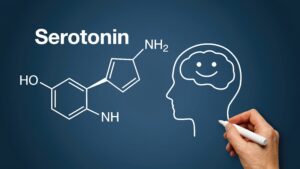 Serotonin is a neurotransmitter—a chemical messenger that allows nerve cells to communicate with one another. In the brain, it is produced primarily by specialized neurons in areas of the brainstem called the raphe nuclei. From there, these neurons send connections throughout much of the brain, allowing serotonin to influence many different brain functions. Serotonin also plays important roles outside the brain, particularly in the digestive system.
In the brain, serotonin helps regulate a wide range of processes, including mood, sleep, appetite, stress responses, motivation and aspects of cognition. But serotonin does not have one single job. Its effects depend on where it is released, which neural circuits it reaches and which of the many serotonin receptors it activates. For this reason, serotonin is best understood as a regulator of brain activity rather than a chemical responsible for any one function. This is particularly important when considering serotonin and learning. There is no single “learning center” in the brain and no single serotonin pathway responsible for learning. Instead, serotonin interacts with multiple brain regions and neural circuits involved in acquiring, storing and using information.
How Serotonin Supports Learning
Learning requires the brain to change. When we encounter new information or experiences, connections between neurons can become stronger, weaker or otherwise modified. This ability of the nervous system to change in response to experience is known as neural plasticity, and serotonin can influence several forms of it.
One important mechanism is synaptic plasticity, which refers to changes in the strength of communication between neurons. Processes such as long-term potentiation and long-term depression allow neural connections to be strengthened or weakened over time. These changes are considered important cellular mechanisms underlying learning and memory.
Serotonin can influence this process by acting on different receptors located on neurons. Depending on the receptor involved, serotonin may increase or decrease neuronal activity and alter how readily synapses change in response to experience. In this way, serotonin helps regulate the conditions under which the brain learns rather than simply determining whether learning occurs.
Serotonin, Memory and the Hippocampus
One of the brain regions most closely associated with learning and memory is the hippocampus. Located deep within the brain, the hippocampus is particularly important for forming and organizing new memories, including memories of facts, events and places. The hippocampus contains several types of serotonin receptors, allowing serotonin to influence its activity and plasticity. Research has shown that serotonin signaling can affect processes involved in the formation and retrieval of memories, as well as the way hippocampal neurons respond to new experiences.
Serotonin does not work alone in this process. Other neurotransmitters, including dopamine, glutamate and acetylcholine, also play important roles in learning and memory. The brain’s ability to learn depends on the interaction of these systems rather than on any single neurotransmitter.
Serotonin and Learning From Rewards
 Learning isn’t limited to remembering information. Much of everyday learning involves figuring out which actions produce desirable or undesirable outcomes. This is known as reinforcement learning. For example, if someone tries a new route to work and discovers that it saves time, they may be more likely to use that route again. The brain has learned from the outcome of the experience. Similar processes help animals learn which behaviors lead to rewards or help them avoid negative consequences.
Serotonin is involved in these processes and interacts closely with dopamine, another neurotransmitter strongly associated with reward and motivation. While dopamine is often described as a reward chemical, the relationship is more complicated than that, and serotonin can influence how the brain interprets and responds to rewards, punishments and unexpected outcomes. Research suggests that serotonin may be particularly important when an individual needs to adjust behavior based on changing circumstances. This brings serotonin into another important aspect of learning: behavioral flexibility.
Serotonin and Behavioral Flexibility
Learning isn’t just about acquiring information. It also requires the ability to recognize when something we have learned is no longer useful. Imagine learning that a particular strategy works well for solving a problem. If the circumstances change, continuing to use the same strategy may no longer produce the desired result. The brain must recognize the change and adapt. This ability is called behavioral flexibility, and serotonin appears to contribute to it.
Serotonin signaling in brain regions involved in decision-making and behavioral control can influence how readily individuals shift strategies, respond to changing rules and learn from negative or unexpected outcomes. This may be one reason serotonin has such broad effects on behavior. Rather than simply influencing whether something feels good or bad, serotonin can help the brain determine how to respond when circumstances change.
The Role of Serotonin Receptors
One reason the relationship between serotonin and learning is so complicated is that serotonin acts through many different receptors. Scientists have identified numerous serotonin receptor subtypes, and each can have different effects on neuronal activity. For example, activating one serotonin receptor may increase the excitability of a particular neuron, while activating another may reduce it. These effects can also vary depending on the brain region and neural circuit involved.
This means that serotonin does not function as a simple “on” or “off” switch for learning. Saying that “serotonin improves learning” is therefore an oversimplification. Serotonin may facilitate certain forms of learning under particular circumstances while having different effects on other types of learning. Researchers increasingly focus on specific serotonin pathways and receptor systems rather than treating serotonin as a single, uniform signal.
For the same reason, more serotonin does not necessarily mean better learning. The brain depends on carefully regulated serotonin signaling, and different neural circuits may require different levels and patterns of activity. Simply increasing serotonin throughout the brain does not automatically improve learning or memory. Changing serotonin signaling can produce different effects depending on the receptor involved, the brain region affected, the timing of the change and the type of learning being studied.
This is also why findings from studies of serotonin-related medications need to be interpreted carefully. A medication that changes serotonin signaling may influence mood, anxiety, cognition or behavior in ways that cannot be predicted simply by knowing that it increases or decreases serotonin activity. Understanding serotonin’s role in learning therefore requires looking beyond overall serotonin levels to the specific receptors, pathways and brain circuits involved.
Greater Implications for Everyday Learning
The research on serotonin and learning helps explain why cognitive function cannot be separated completely from the brain’s broader regulatory systems. Learning depends on attention, motivation, emotional state, memory, reward processing and the ability to adapt—all processes that serotonin can influence. However, this does not mean that taking a serotonin-boosting supplement or medication will make someone learn faster or remember more. Healthy learning depends on many factors, including sleep, attention, practice, physical health, stress levels and the way information is presented. Serotonin is one component of a much larger system. The research does, however, highlight why maintaining healthy brain function matters. Adequate sleep, regular physical activity, a nutritious diet and effective stress management all support the brain systems involved in learning, although none should be viewed as a simple way to “increase serotonin” and thereby improve learning.
How Serotonin Shapes the Learning Process
 The connection between serotonin and learning is complex but increasingly well understood. Serotonin influences the brain processes that allow neurons to adapt to experience, including forms of synaptic plasticity involved in learning and memory. It also interacts with brain regions involved in memory formation, reward processing, decision-making and behavioral flexibility.
Rather than acting as a simple switch for learning, serotonin helps regulate the conditions under which learning takes place. Its effects depend on the specific neural pathway, receptor, brain region and type of learning involved. This helps explain why serotonin can influence everything from memory formation to learning from rewards and adapting when circumstances change. Ultimately, serotonin is just one part of the brain’s remarkably complex learning system. Understanding its role may not lead to a simple formula for improving memory or learning, but it is helping researchers uncover how the brain adapts to experience—and how chemical signals help make that adaptation possible.